Distributed LLM Inference
Source: 15_distributed_llm_inference
An HTTP server that accepts plain-text prompts and streams LLM responses back. The LLM call runs on a Mélodium cloud runner; the ml package only needs to be available on the runner, not on the front-end machine. The front-end requires no ML dependencies at all.
Running
melodium run 15_distributed_llm_inference/Compo.toml \
  --api_token  "my-api-token" \
  --openai_key sk-... \
--port 8080api_token here authenticates against a Mélodium Services API, such as Cadence.CI . openai_key is an OpenAI API key, forwarded to the remote runner.
$ curl -X POST http://127.0.0.1:8080/chat \
       -H "Content-Type: text/plain" \
       -d "Explain the Mélodium dataflow model in one sentence."
Mélodium is a dataflow programming language…
How it works
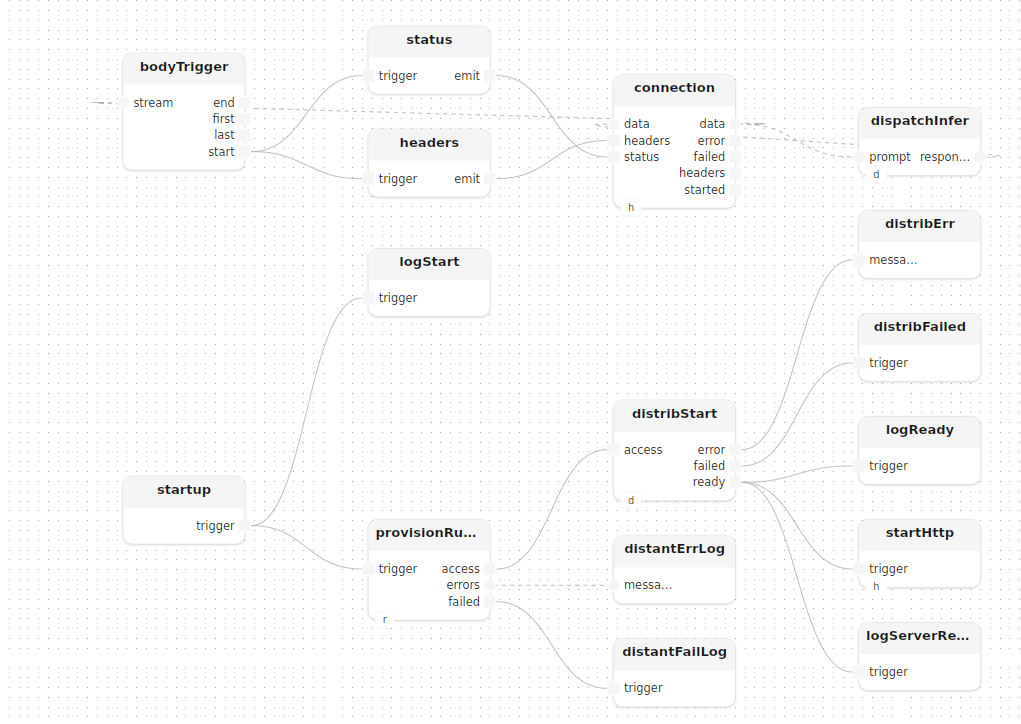
server instantiates the DistantEngine, DistributionEngine, and local HttpServer models. The Assistant model (an LLM wrapper) is defined here but only instantiated on the remote runner:
model Assistant(const openai_key: string) : RemoteLlm {
    backend     = "openai"
    api_key     = |wrap<string>(openai_key)
    base_url    = ""
    model       = "gpt-4o-mini"
    system      = "You are a concise and helpful assistant."
    max_tokens  = |wrap<u64>(1024)
    temperature = _
    top_p       = _
    timeout     = _
}

model runner: DistantEngine(api_url=|wrap<string>("https://api.melodium.tech/0.1"), api_token=|wrap<string>(api_token))
model distributor: DistributionEngine(
  treatment = "distributed_llm_inference/main::inferText",
  version   = "0.1.0"
)
model httpServer: HttpServer(host=|from_ipv4(|localhost_ipv4()), port=port)
The front-end only needs the http, distrib, and work packages; the ml package (and its API call logic) lives entirely on the runner.
Passing const parameters to the remote treatment
inferText needs openai_key to configure its Assistant model, but const parameters cannot be passed through streams. They are sent via the distribution engine’s start call, once, at connection time:
provisionRunner: distant[distant_engine=runner](
    max_duration = 600,
    memory       = 512, // MB
    cpu          = 1000, // millicores
    storage      = 512, // MB
    edition      = _,
    arch         = _,
    volumes      = [],
    containers   = [],
    service_containers = [],
    tags         = []
)
startup.trigger -> provisionRunner.trigger,access -> distribStart.access

distribStart: start[distributor=distributor](params=|map([|entry<string>("openai_key", openai_key)]))
On the remote side, inferText declares the same parameter as const:
treatment inferText(const openai_key: string)
  model llm: Assistant(openai_key=openai_key)
  input  prompt:   Stream<byte>
  output response: Stream<byte>
A var parameter would instead require per-invocation data, which is what sendStream / recvStream are for.
Only after distribStart.ready fires do both startHttp and the ready log run, so no request can arrive before the remote worker is connected:
startHttp[http_server=httpServer]()
distribStart.ready -> startHttp.trigger
Dispatching each request
dispatchInfer wraps distribute, sendStream, and recvStream:
treatment dispatchInfer[distributor: DistributionEngine]()
  input  prompt:   Stream<byte>
  output response: Stream<byte>
{
    trig: trigger<byte>()
    dist: distribute[distributor=distributor]()

    Self.prompt -> trig.stream,start -> dist.trigger

    sendPrompt:   sendStream<byte>[distributor=distributor](name="prompt")
    recvResponse: recvStream<byte>[distributor=distributor](name="response")

    dist.distribution_id -> sendPrompt.distribution_id
    dist.distribution_id -> recvResponse.distribution_id

    Self.prompt       -> sendPrompt.data
    recvResponse.data -> Self.response
}

connection.data -> dispatchInfer.prompt,response -> connection.data
The stream names ("prompt", "response") match inferText’s own port names.
The remote inferText treatment
treatment inferText(const openai_key: string)
  model llm: Assistant(openai_key=openai_key)
  input  prompt:   Stream<byte>
  output response: Stream<byte>
{
    decodePrompt: decode()
    Self.prompt -> decodePrompt.data,text -> doChat.prompt

    doChat: chat[llm=llm]()

    chatErrLog: logErrors(label="llm")
    doChat.error -> chatErrLog.messages

    encodeResponse: encode()
    doChat.response -> encodeResponse.text,data -> Self.response
}
decode converts the prompt bytes to a UTF-8 string, chat calls the LLM (GPT-4o-mini via OpenAI) and emits response tokens as Stream<string>, and encode converts each token back to bytes before it flows to Self.response. Because doChat.response streams token by token, recvResponse.data forwards directly into connection.data: the HTTP client sees tokens appear as they are generated, with no intermediate buffering.

Dependencies
[dependencies]
std      = "0.10.2"  # core flows, logging, data structures
http     = "0.10.2"  # HTTP server and client
net      = "0.10.2"  # IP address helpers
encoding = "0.10.2"  # UTF-8 encode / decode
work     = "0.10.2"  # cloud runner provisioning
distrib  = "0.10.2"  # stream distribution across runners
ml       = "0.10.2"  # LLM, STT, TTS and local model inference