Voice Q&A (Local)
A fully offline voice Q&A pipeline: microphone → local Whisper (speech-to-text) → local Mistral 7B (text generation) → log and file output. No API keys are required after the initial model download from HuggingFace.
Running
melodium run 07_voice_qa_local/Compo.toml --output qa.txt[…] info: pipeline: both models ready, listening…
[…] info: answer: Mélodium is a dataflow programming language designed for …Requires approximately 14 GB of RAM for Mistral 7B.
How it works
Four models are declared: two HfHub pointers (one per model repository) and two inference models:
model WhisperHub() : HfHub   { repo_id = "openai/whisper-tiny" }
model MistralHub() : HfHub   { repo_id = "mistralai/Mistral-7B-v0.1" }
model Asr()        : Whisper {}
model Llm()        : Mistral { temperature = 0.7, top_p = 0.9, max_new_tokens = 256 }
Parallel model loading
Both models are fetched concurrently from the moment startup fires:
treatment main(const output: string = "qa.txt")
  model whisperHub: WhisperHub()
  model mistralHub: MistralHub()
  model asr:        Asr()
  model llm:        Llm()
{
    startup()
    fetchAsr:  fetch[hub=whisperHub]()
    fetchLlm:  fetch[hub=mistralHub]()
    loadAsr:   loadWhisper[whisper=asr]()
    loadLlm:   loadMistral[mistral=llm]()

    startup.trigger      -> fetchAsr.trigger
    startup.trigger      -> fetchLlm.trigger
    fetchAsr.safetensors -> loadAsr.safetensors
    fetchAsr.tokenizer   -> loadAsr.tokenizer
    fetchLlm.safetensors -> loadLlm.safetensors
    fetchLlm.tokenizer   -> loadLlm.tokenizer

    logReady: logInfoMessage(label="pipeline", message="both models ready — listening…")
    loadLlm.loaded -> logReady.trigger

    asrDecode:  decode[whisper=asr]()
    record:     recordMono(device=_, sample_rate=_)

    loadAsr.loaded -> record.trigger
    loadAsr.loaded -> asrDecode.ready
    record.signal  -> asrDecode.audio

    promptLlm[llm=llm]()
    asrDecode.transcribed -> promptLlm.question

    logAnswer:   logInfos(label="answer")
    write:       writeTextLocal(path=output, append=true)

    promptLlm.answer --> logAnswer.messages
    promptLlm.answer --> write.text
}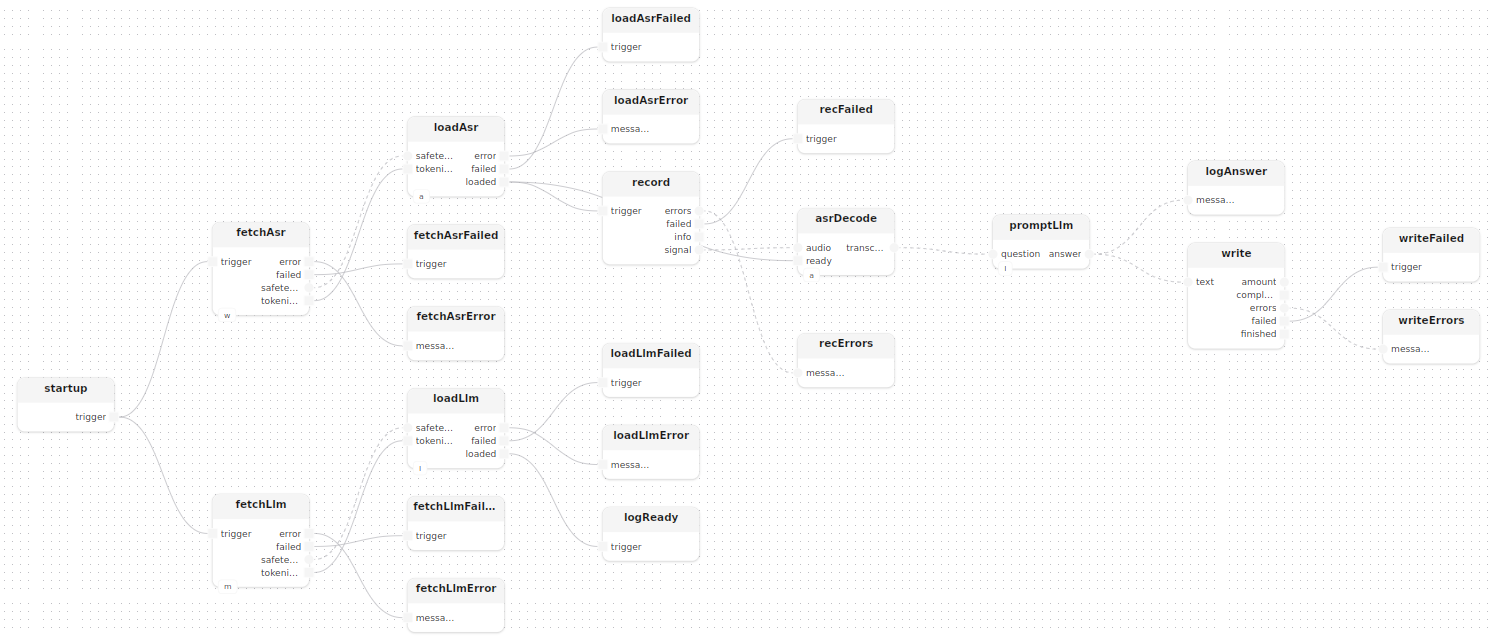
Audio capture starts as soon as the ASR model is loaded (loadAsr.loaded). The LLM can finish loading in parallel; if it is not ready by the time the first transcription arrives, the dataflow naturally blocks until it is.
Prompt formatting
Each transcribed segment is formatted into the Mistral [INST] prompt template before being sent to the model:
treatment promptLlm[llm: Mistral]()
  input  question: Stream<string>
  output answer:   Stream<string>
{
    wrapEntry: entry(key="q")
    fmt:       format(format="[INST] {q} [/INST]")
    generate[mistral=llm]()

    Self.question -> wrapEntry.value,map -> fmt.entries,formatted -> generate.prompt,generated -> Self.answer
}
entry(key="q") wraps the string into a StringMap, and format(format="[INST] {q} [/INST]") interpolates it. This avoids string concatenation and keeps the template readable.
Dependencies
[dependencies]
std    = "0.10.2"  # core flows, logging, data structures
fs     = "0.10.2"  # local file I/O
audio  = "0.10.2"  # audio decode / encode / resample
record = "0.10.2"  # microphone capture
ml     = "0.10.2"  # LLM, STT, TTS and local model inference