Meeting Summary Service
Source: 10_meeting_summary_service
An HTTP server that accepts raw audio uploads, transcribes them with the ElevenLabs Scribe API, generates a structured meeting summary with Claude Sonnet, and streams the summary back as the HTTP response. Each request is handled in its own track; the server processes multiple simultaneous uploads without any explicit thread management.
Running
melodium run 10_meeting_summary_service/Compo.toml \
  --anthropic_key sk-ant-... \
--elevenlabs_key el-...anthropic_key is an Anthropic API key. elevenlabs_key is an ElevenLabs API key.
$ curl -X POST http://127.0.0.1:8080/summarise \
       --data-binary @meeting.wav \
       -H "Content-Type: audio/wav"
## Meeting Summary

**Overview:** …

**Key decisions:**
- …

**Action items:**
- …
How it works
Two models wrap the remote STT and LLM backends:
model Stt(const elevenlabs_key: string) : RemoteStt {
    backend  = "elevenlabs"
    api_key  = |wrap<string>(elevenlabs_key)
    base_url = ""
    model    = "scribe_v1"
}

model Llm(const anthropic_key: string) : RemoteLlm {
    backend     = "anthropic"
    api_key     = |wrap<string>(anthropic_key)
    base_url    = ""
    model       = "claude-sonnet-4-6"
    system      = "You are an expert meeting assistant. Given a raw transcript, produce a concise, structured summary with: key decisions, action items, and a one-paragraph overview."
    max_tokens  = 512
    temperature = 0.4
    top_p       = _
    timeout     = _
}
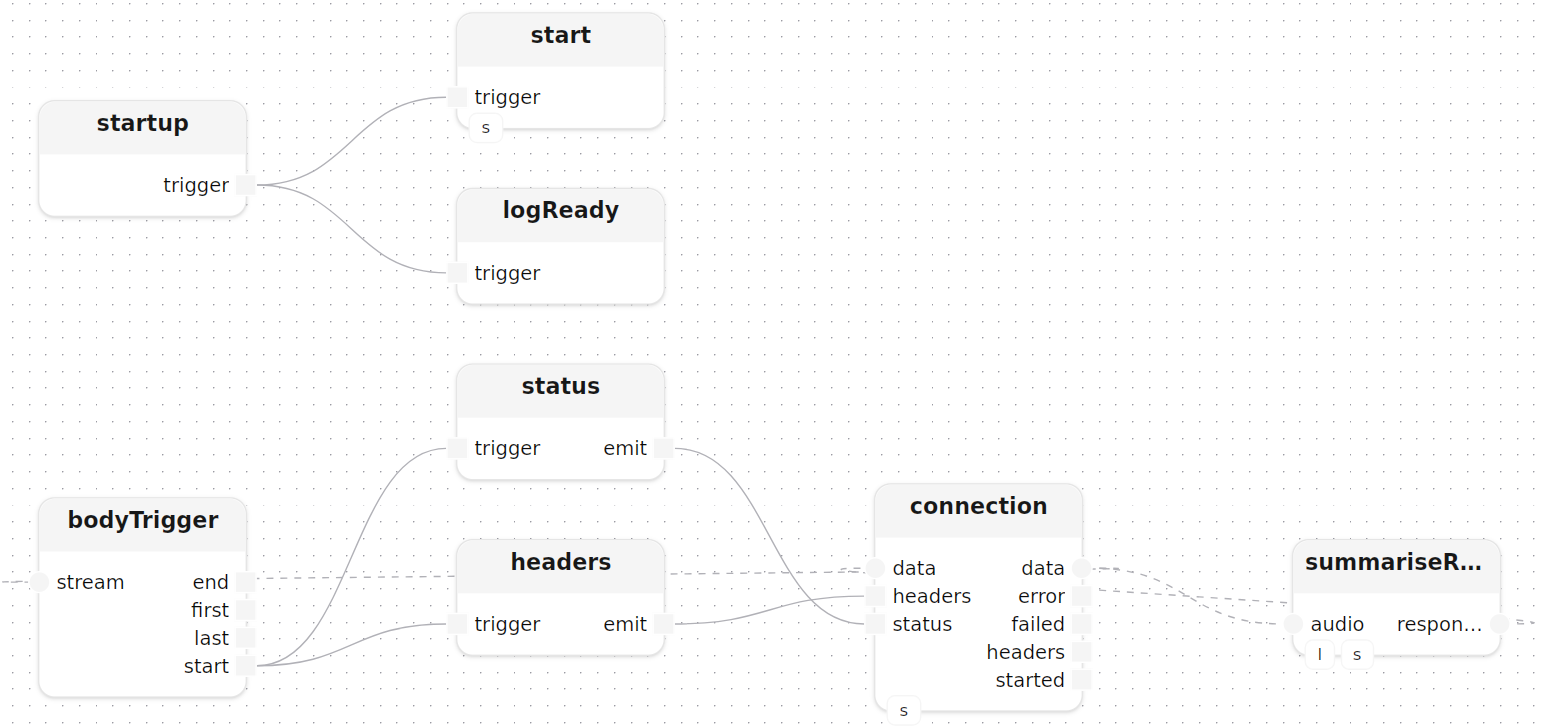
Stt uses the ElevenLabs scribe_v1 model. Llm uses Claude Sonnet with a structured summarisation system prompt and a lower temperature (0.4) to produce focused, consistent output. All three models, including the HttpServer, are instantiated at startup:
treatment main(
    const anthropic_key: string,
    const elevenlabs_key: string,
    const port:       u16 = 8080
)
  model server: HttpServer(host=|from_ipv4(|localhost_ipv4()), port=port)
  model stt:    Stt(elevenlabs_key=elevenlabs_key)
  model llm:    Llm(anthropic_key=anthropic_key)
{
    startup()
    start[http_server=server]()
    logReady: logInfoMessage(label="service", message="meeting summary service ready")

    startup.trigger -> start.trigger
    startup.trigger -> logReady.trigger

    connection[http_server=server](method=|post(), route="/summarise")

    status:  emit<HttpStatus>(value=|ok())
    headers: emit<StringMap>(value=|map([]))
    bodyTrigger: trigger<byte>()

    connection.data -> bodyTrigger.stream,start --> status.trigger,emit  -> connection.status
                       bodyTrigger.start --------> headers.trigger,emit -> connection.headers

    summariseRequest[stt=stt, llm=llm]()
    connection.data -> summariseRequest.audio,response -> connection.data
}
Per-request pipeline
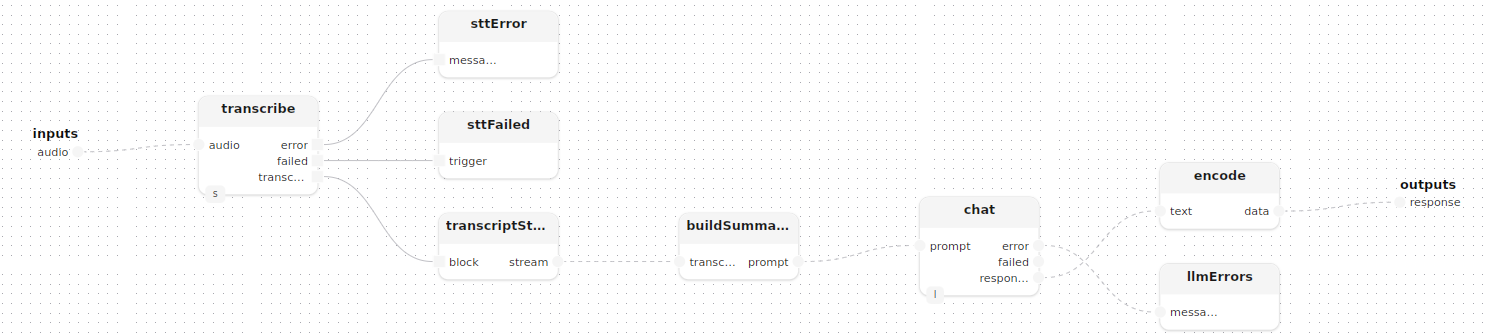
The summariseRequest sub-treatment handles everything for one request:
treatment summariseRequest[stt: RemoteStt, llm: RemoteLlm]()
  input  audio:    Stream<byte>
  output response: Stream<byte>
{
    transcribe[stt=stt]()
    transcriptStream: stream<string>()

    sttFailed: logErrorMessage(label="stt", message="transcription failed")
    sttError:  logError(label="stt")

    Self.audio -> transcribe.audio

    transcribe.transcript -> transcriptStream.block,stream -> buildSummaryPrompt.transcript
    transcribe.failed     -> sttFailed.trigger
    transcribe.error      -> sttError.message

    buildSummaryPrompt()
    chat[llm=llm]()
    encode()

    llmErrors: logErrors(label="llm")

    buildSummaryPrompt.prompt -> chat.prompt,response -> encode.text,data -> Self.response

    chat.error -> llmErrors.messages
}
transcribe returns a Block<string>. The stream<string>() adapter converts it to a Stream<string> so it can flow into buildSummaryPrompt, which wraps the raw transcript in a prompt template using entry and format:
treatment buildSummaryPrompt()
  input  transcript: Stream<string>
  output prompt:     Stream<string>
{
    wrapEntry: entry(key="t")
    fmt:       format(format="Here is the meeting transcript:\n\n{t}\n\nPlease produce a structured meeting summary.")

    Self.transcript -> wrapEntry.value,map -> fmt.entries,formatted -> Self.prompt
}
chat from RemoteLlm returns a Stream<string> of response tokens, which are encoded and forwarded directly into connection.data. Summary tokens appear in the HTTP response as they are generated.
Video Explanation
Dependencies
[dependencies]
std      = "0.10.2"  # core flows, logging, data structures
http     = "0.10.2"  # HTTP server and client
net      = "0.10.2"  # IP address helpers
encoding = "0.10.2"  # UTF-8 encode / decode
ml       = "0.10.2"  # LLM, STT, TTS and local model inference