Realtime Voice Assistant
Source: 11_realtime_voice_assistant
A voice assistant that transcribes microphone audio with local Whisper and sends each segment to a language model for a response. Two entrypoints let you choose between a remote LLM (streaming tokens) or a fully local Mistral 7B (no API key needed).
Running
With a remote LLM (GPT-4o):
melodium run 11_realtime_voice_assistant/Compo.toml --openai_key sk-...openai_key is an OpenAI API key.
Fully local (no API key, requires ~14 GB RAM):
melodium run 11_realtime_voice_assistant/Compo.toml localonly[…] info: assistant: ready, speak into the microphone
[…] info: you: What time is it in Tokyo?
[…] info: assistant: Tokyo is in Japan Standard Time (JST), which is UTC+9…How it works
Both entrypoints share the same Whisper loading sequence and models:
model WhisperHub() : HfHub   { repo_id = "openai/whisper-tiny" }
model Asr()        : Whisper {}
The difference lies only in which LLM backend is used downstream.
main: local Whisper + remote LLM
The remote LLM is a RemoteLlm model configured for GPT-4o with a short, concise system prompt:
model RemoteAssistant(const openai_key: string) : RemoteLlm {
    backend     = "openai"
    api_key     = |wrap<string>(openai_key)
    base_url    = ""
    model       = "gpt-4o"
    system      = "You are a concise voice assistant. Answer in plain text, one short paragraph."
    max_tokens  = |wrap<u64>(256)
    temperature = |wrap<f32>(0.6)
    top_p       = _
    timeout     = _
}
main fetches and loads Whisper first, then only starts recording once loading has completed:
treatment main(const openai_key: string)
  model whisperHub: WhisperHub()
  model asr:        Asr()
  model llm:        RemoteAssistant(openai_key=openai_key)
{
    fetchAsr: fetch[hub=whisperHub]()
    loadAsr:  loadWhisper[whisper=asr]()

    startup.trigger      -> fetchAsr.trigger
    fetchAsr.safetensors -> loadAsr.safetensors
    fetchAsr.tokenizer   -> loadAsr.tokenizer

    record:    recordMono(device=_, sample_rate=_)
    asrDecode: decode[whisper=asr]()

    loadAsr.loaded -> record.trigger
    loadAsr.loaded -> asrDecode.ready
    record.signal  -> asrDecode.audio
}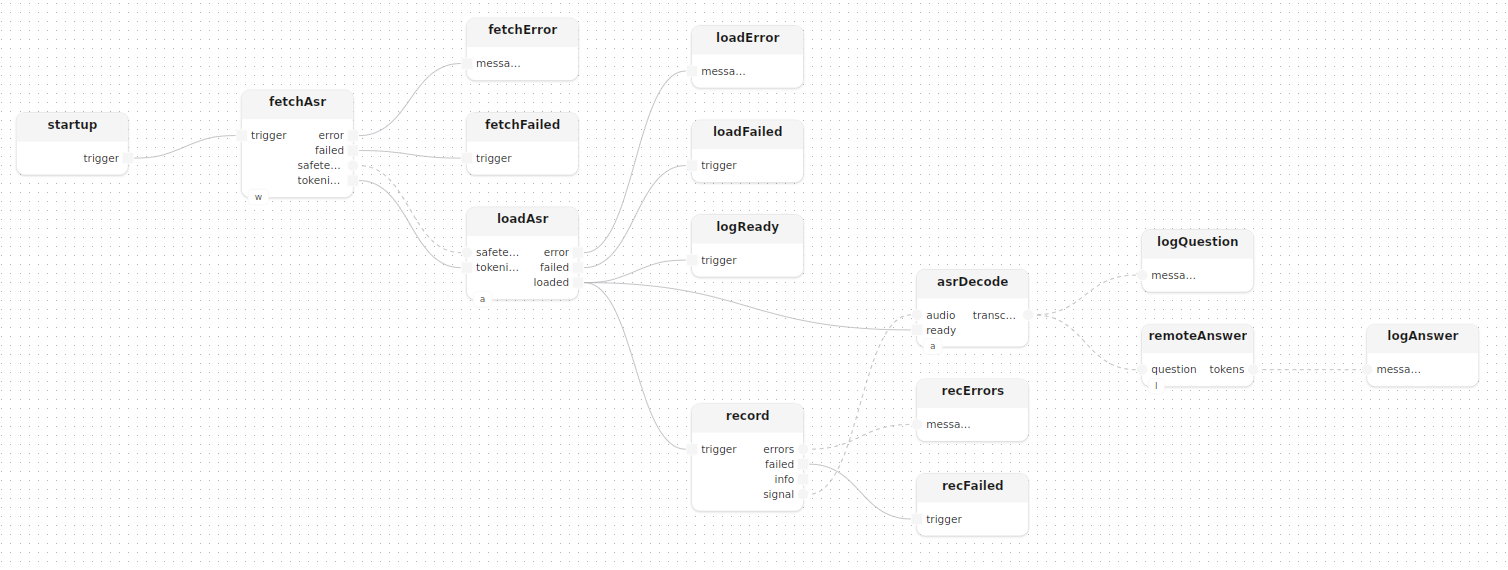
Each transcribed segment fans out to two consumers simultaneously:
asrDecode.transcribed -> logQuestion.messages
asrDecode.transcribed -> remoteAnswer.question
remoteAnswer[llm: RemoteLlm] wraps the question in "[Question] {q}" and calls llmStream, which emits tokens one by one as a Stream<string>, printed to the log in real time without waiting for the full response:
treatment remoteAnswer[llm: RemoteLlm]()
  input  question: Stream<string>
  output tokens:   Stream<string>
{
    wrapEntry: entry(key="q")
    fmt:       format(format="[Question] {q}")
    llmStream[llm=llm]()

    Self.question -> wrapEntry.value,map -> fmt.entries,formatted -> llmStream.prompt,token -> Self.tokens
}localonly: local Whisper + local Mistral
The localOnly entrypoint adds two more models for a fully local Mistral 7B backend:
model MistralHub() : HfHub   { repo_id = "mistralai/Mistral-7B-v0.1" }
model LocalLlm()   : Mistral {
    temperature    = 0.7
    top_p          = 0.9
    max_new_tokens = 200
}
Both Whisper and Mistral are fetched in parallel from startup, and load independently:
treatment localOnly()
  model whisperHub: WhisperHub()
  model mistralHub: MistralHub()
  model asr:        Asr()
  model llm:        LocalLlm()
{
    fetchAsr: fetch[hub=whisperHub]()
    fetchLlm: fetch[hub=mistralHub]()
    loadAsr:  loadWhisper[whisper=asr]()
    loadLlm:  loadMistral[mistral=llm]()

    startup.trigger      -> fetchAsr.trigger
    startup.trigger      -> fetchLlm.trigger
    fetchAsr.safetensors -> loadAsr.safetensors
    fetchAsr.tokenizer   -> loadAsr.tokenizer
    fetchLlm.safetensors -> loadLlm.safetensors
    fetchLlm.tokenizer   -> loadLlm.tokenizer
}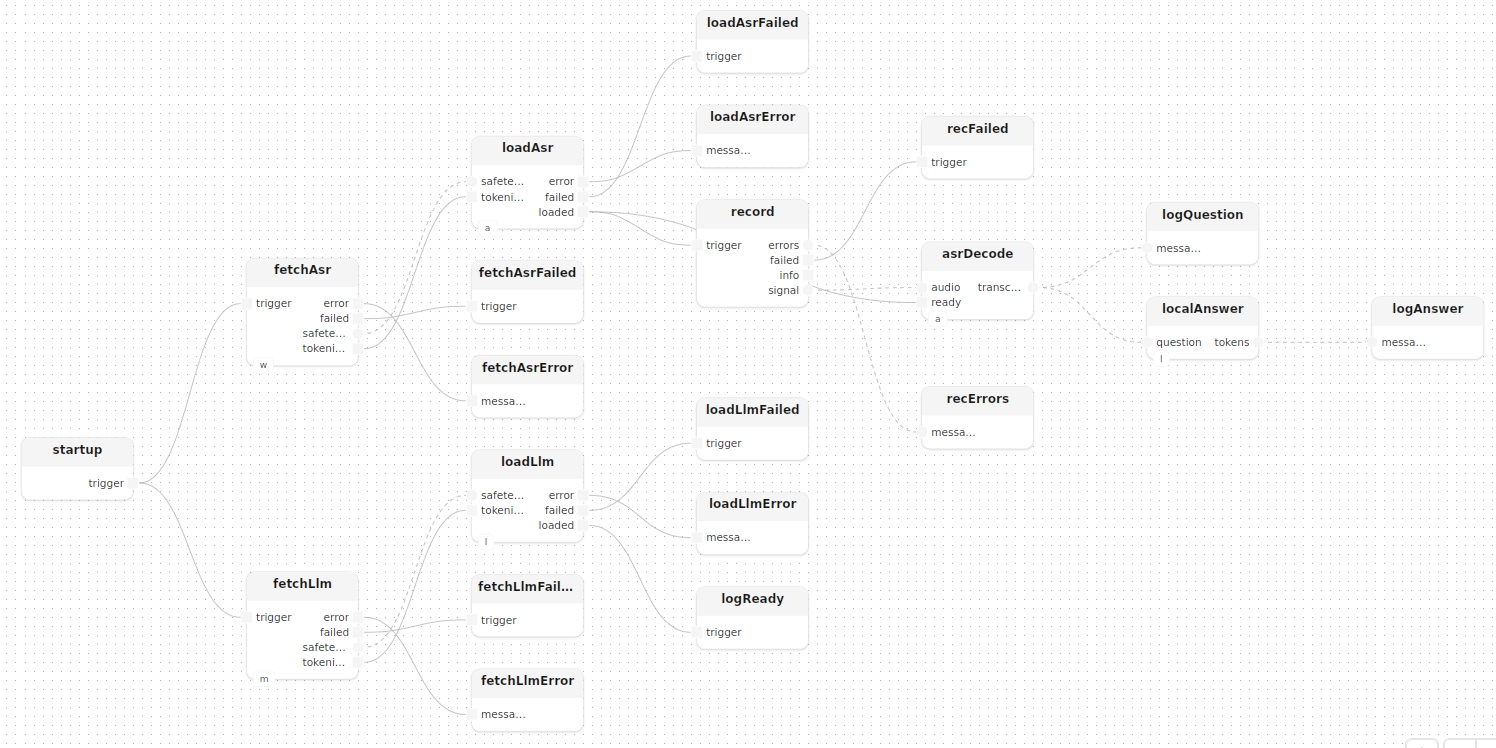
Recording starts as soon as Whisper is loaded (loadAsr.loaded), which may happen before Mistral finishes loading; each transcribed segment is still handed to localAnswer[llm: Mistral], which formats it in Mistral’s instruction style and calls generate instead of llmStream:
treatment localAnswer[llm: Mistral]()
  input  question: Stream<string>
  output tokens:   Stream<string>
{
    wrapEntry: entry(key="q")
    fmt:       format(format="[INST] {q} [/INST]")
    generate[mistral=llm]()

    Self.question -> wrapEntry.value,map -> fmt.entries,formatted -> generate.prompt,generated -> Self.tokens
}
Shared interface, different backends
remoteAnswer and localAnswer both expose the same question: Stream<string> in / tokens: Stream<string> out interface, so the fan-out and logging logic in each entrypoint is identical. The entrypoint does not know or care which one it calls; swapping backends is purely a model-level concern.
Dependencies
[dependencies]
std    = "0.10.2"  # core flows, logging, data structures
audio  = "0.10.2"  # audio decode / encode / resample
record = "0.10.2"  # microphone capture
ml     = "0.10.2"  # LLM, STT, TTS and local model inference