Speech Transcription
Source: 02_speech_transcription
Transcribes audio to text using a local Whisper model downloaded automatically from Hugging Face on first run. Two entrypoints: main for live microphone input, fromfile for transcribing an existing audio file.
Running
Live transcription from the microphone:
melodium run 02_speech_transcription/Compo.tomlTranscribe an audio file:
melodium run 02_speech_transcription/Compo.toml fromfile -- --input_file speech.wavExpected output:
[…] info: transcription: Hello, this is a test.
[…] info: transcription: The model is running locally.
How it works
Two models are declared at the top of each entrypoint:
model Hub()    : HfHub   { repo_id = "openai/whisper-tiny" }
model Speech() : Whisper {}
Hub points to the HfHub repository for Whisper tiny. Speech is an empty Whisper model configuration; default parameters are used.
Model loading sequence
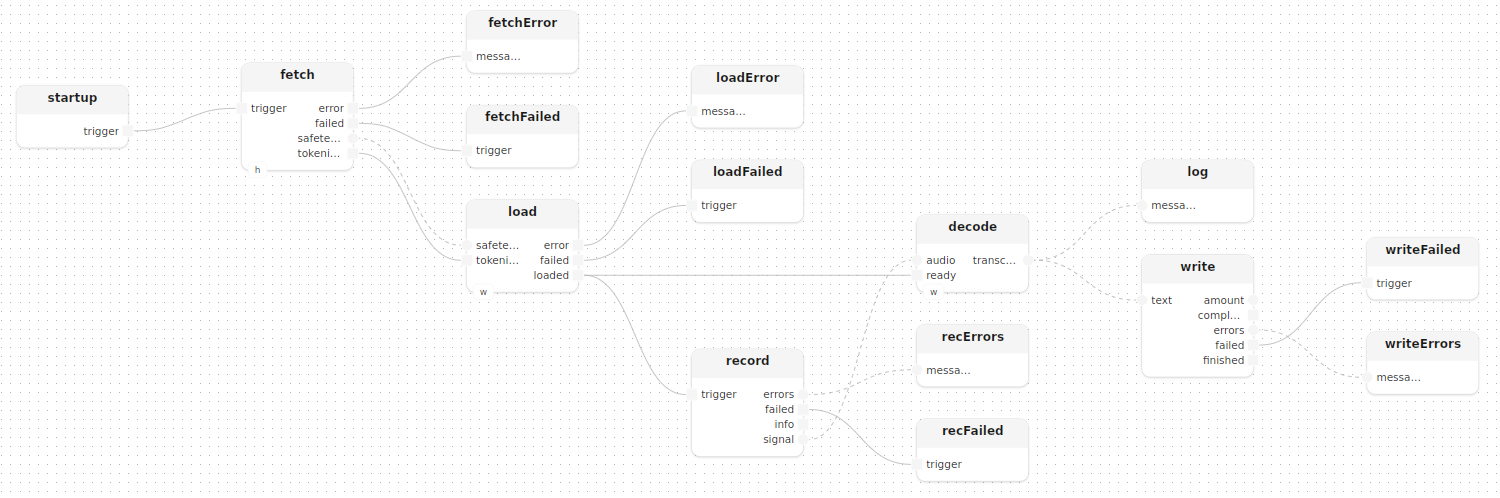
The connections enforce that audio capture only starts once the model is ready:
treatment main(const output: string = "transcription.txt")
  model hub:     Hub()
  model whisper: Speech()
{
    startup()
    fetch[hub=hub]()
    load[whisper=whisper]()
    decode[whisper=whisper]()

    record:       recordMono(device=_, sample_rate=_)
    log:          logInfos(label="transcription")
    write:        writeTextLocal(path=output, append=true)

    startup.trigger    -> fetch.trigger
    fetch.safetensors  -> load.safetensors
    fetch.tokenizer    -> load.tokenizer
    load.loaded        -> decode.ready
    load.loaded        -> record.trigger
    record.signal      -> decode.audio
startup triggers fetch, which downloads weights and tokenizer; load initialises the model; load.loaded simultaneously gates both decode.ready and the audio source. No synchronisation primitive is needed; the dataflow itself enforces the ordering.
Fan-out to log and file
Once Whisper produces a transcribed segment, it is forwarded to two treatments by writing two separate connections from decode.transcribed:
    decode.transcribed --> log.messages
    decode.transcribed --> write.text
}
Both operations run concurrently.
fromfile entrypoint
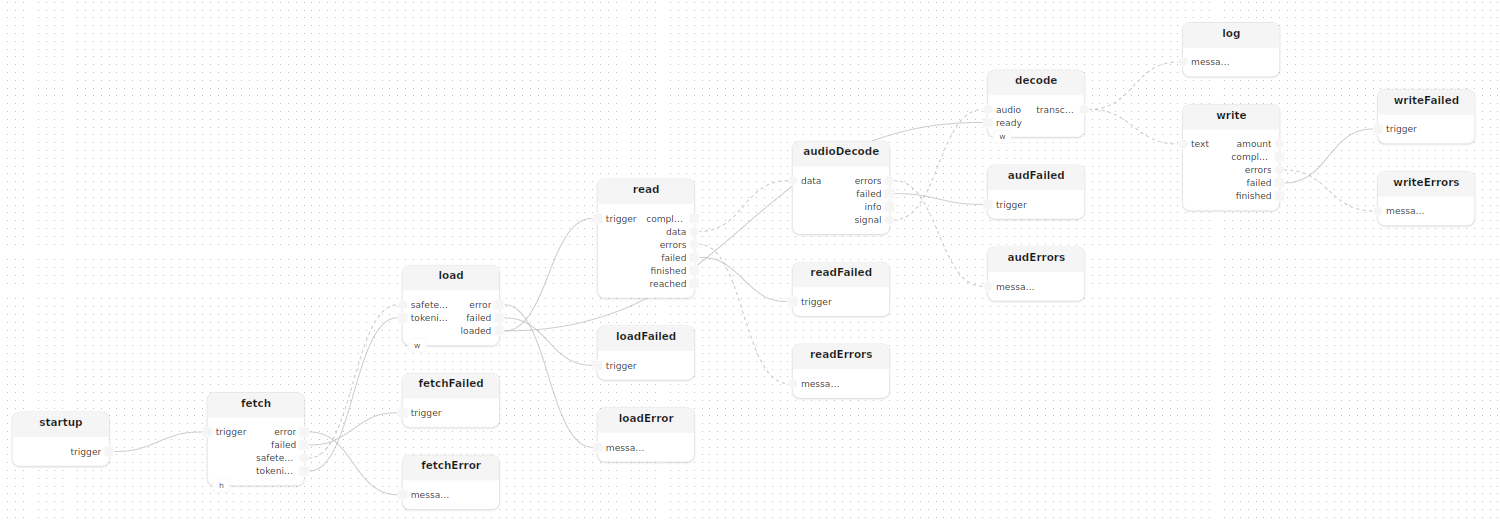
The fromFile entrypoint replaces recordMono with readLocal and decodeMono:
treatment fromFile(
    const input_file:  string,
    const output:      string = "transcription.txt"
)
  model hub:     Hub()
  model whisper: Speech()
{
    startup()
    fetch[hub=hub]()
    load[whisper=whisper]()
    decode[whisper=whisper]()

    read:         readLocal(path=input_file)
    audioDecode:  decodeMono(hint="wav")
    log:          logInfos(label="transcription")
    write:        writeTextLocal(path=output, append=false)

    startup.trigger    -> fetch.trigger
    fetch.safetensors  -> load.safetensors
    fetch.tokenizer    -> load.tokenizer
    load.loaded        -> decode.ready
    load.loaded        -> read.trigger
    read.data          -> audioDecode.data
    audioDecode.signal -> decode.audio
    decode.transcribed --> log.messages
    decode.transcribed --> write.text
}
The decodeMono(hint="wav") treatment handles container format detection transparently; the same pipeline works for WAV, MP3, FLAC, and other formats.
Dependencies
[dependencies]
std    = "0.10.2"  # core flows, logging, data structures
fs     = "0.10.2"  # local file I/O
audio  = "0.10.2"  # audio decode / encode / resample
record = "0.10.2"  # microphone capture
ml     = "0.10.2"  # LLM, STT, TTS and local model inference